Real-time encounter capture
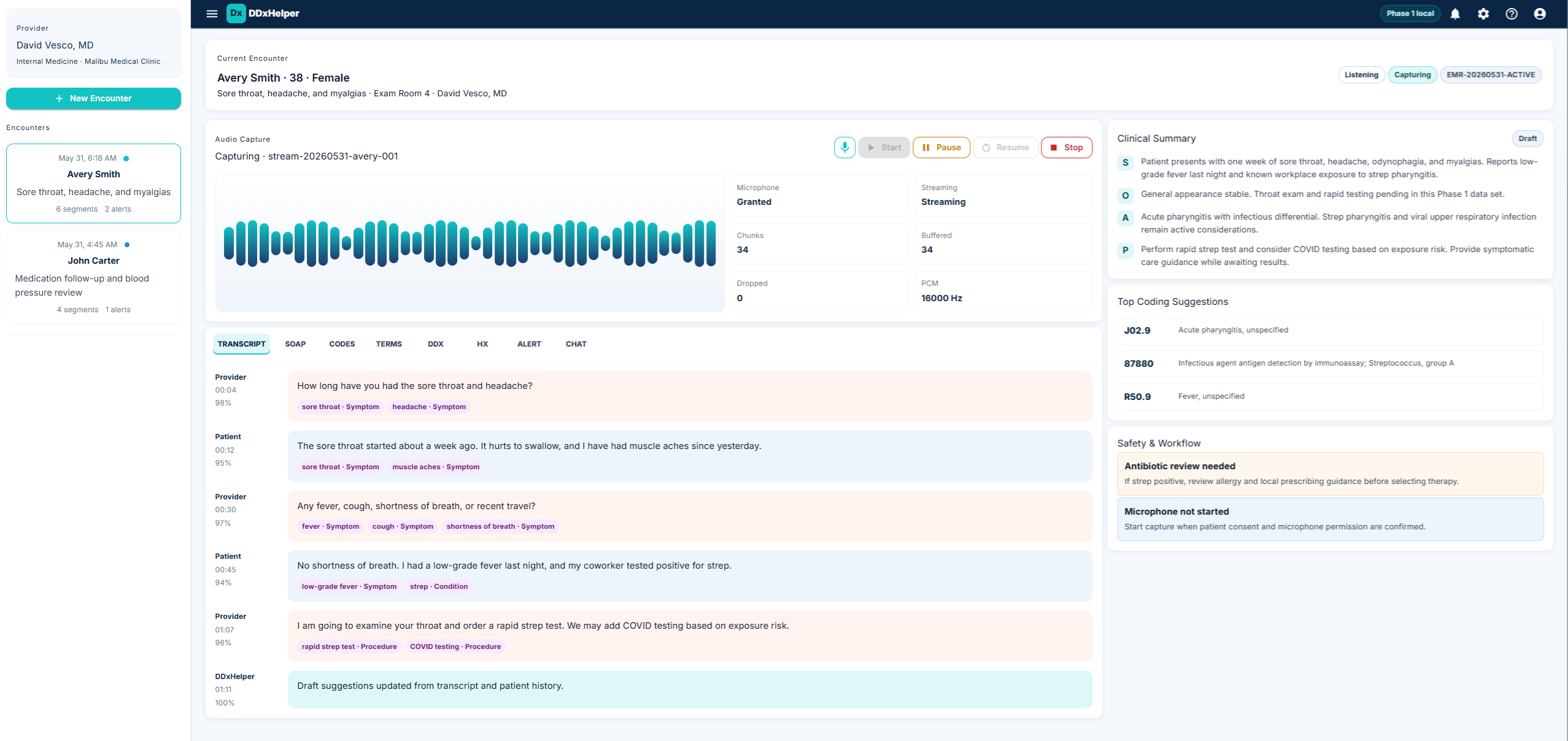
Securely capture the provider-patient conversation as it happens.
DDxHelper helps healthcare professionals turn provider-patient conversations into structured clinical documentation, medical terms, coding suggestions, and differential diagnosis support for provider review.
Designed for healthcare teams
DDxHelper listens to provider-patient encounters and converts the conversation into a structured clinical artifact: a real-time transcript, a draft SOAP note, extracted medical terms, ICD-10-CM coding suggestions, and treatment suggestions — all surfaced for provider review.
A clinical-first workflow built around how providers actually document.
Provider starts the encounter and DDxHelper securely captures the clinical conversation.
Transcript, medical terms, SOAP note, and coding suggestions are generated.
Provider reviews, edits, and approves the output. Nothing is signed without provider review.
Ten focused capabilities that work together to support documentation, coding, and differential diagnosis.
Securely capture the provider-patient conversation as it happens.
Convert audio into a clean clinical transcript suitable for review.
Differentiate provider, patient, and other voices in the encounter.
Draft structured SOAP notes ready for provider edits and approval.
Surface relevant clinical concepts from the conversation.
Generate coding ideas to support faster, more consistent billing review.
Organize potential differentials and treatment suggestions for the provider to consider.
Ask about transcript evidence, coding suggestions, or draft note language — answers scoped to the current encounter.
Every output is reviewed, edited, and approved by a licensed provider.
Use DDxHelper from the device that fits the encounter and the day.
DDxHelper helps reduce the documentation burden that pulls clinicians away from the encounter. Providers stay in the conversation; DDxHelper organizes the rest for review.
Subjective
Adult patient reports 3-day history of sore throat, low-grade fever, mild cough, and nasal congestion. Denies ear pain, chest pain, or shortness of breath.
Objective
Vitals stable. Oropharynx mildly erythematous without exudate. Nasal mucosa congested. Lungs clear bilaterally. No lymphadenopathy noted.
Assessment
Findings consistent with acute upper respiratory infection, viral etiology most likely.
Plan
Supportive care, fluids, rest. Return if symptoms worsen or persist beyond 7–10 days. Patient education on warning signs reviewed.
DDxHelper organizes potential differentials for review only. Clinical reasoning, diagnosis, and treatment decisions remain with the licensed healthcare professional.
Built with providers and clinical leaders to fit the way care actually happens.
AI surfaces drafts and suggestions — providers stay in control of clinical decisions.
Tenant-aware SaaS designed with HIPAA-aligned security and privacy principles.
DDxHelper surfaces transcripts, SOAP drafts, coding suggestions, and differential diagnosis support as reviewable work products. Licensed clinicians remain responsible for edits, approval, diagnosis, treatment, and final documentation decisions.
Providers can review, edit, and approve documentation from the device that fits the moment.
Sign in from any modern browser at portal.ddxhelper.com.
A focused desktop experience for in-clinic and admin workflows.
Stay productive at the point of care with mobile review and approval.
Tenant-aware SaaS architecture, encryption in transit and at rest, role-based access control, and audit logging — designed for healthcare from the ground up.
Encryption in transit and at rest, with strong key management.
Role-based access aligned to clinical responsibilities.
Detailed event logging to support oversight and review.
How DDxHelper keeps clinicians in control of documentation, coding, and differential support.
A practical look at how encounter capture becomes structured documentation for review.
Principles for applying clinical AI as decision support rather than autonomous diagnosis.